When Marketing Tools Multiply Without a Plan
Most businesses don’t have a marketing problem.
They have a tool problem.
Over time, marketing tools tend to accumulate the same way apps accumulate on a phone. One gets installed to solve a problem. Then another gets added to fill a gap. Then someone recommends a new platform that promises to make everything easier.
Eventually, the stack looks something like this:
A CRM.
An email marketing platform.
A social media scheduler.
A landing page builder.
A reporting dashboard.
An automation tool.
Maybe two or three AI tools for good measure.
Individually, every tool makes sense.
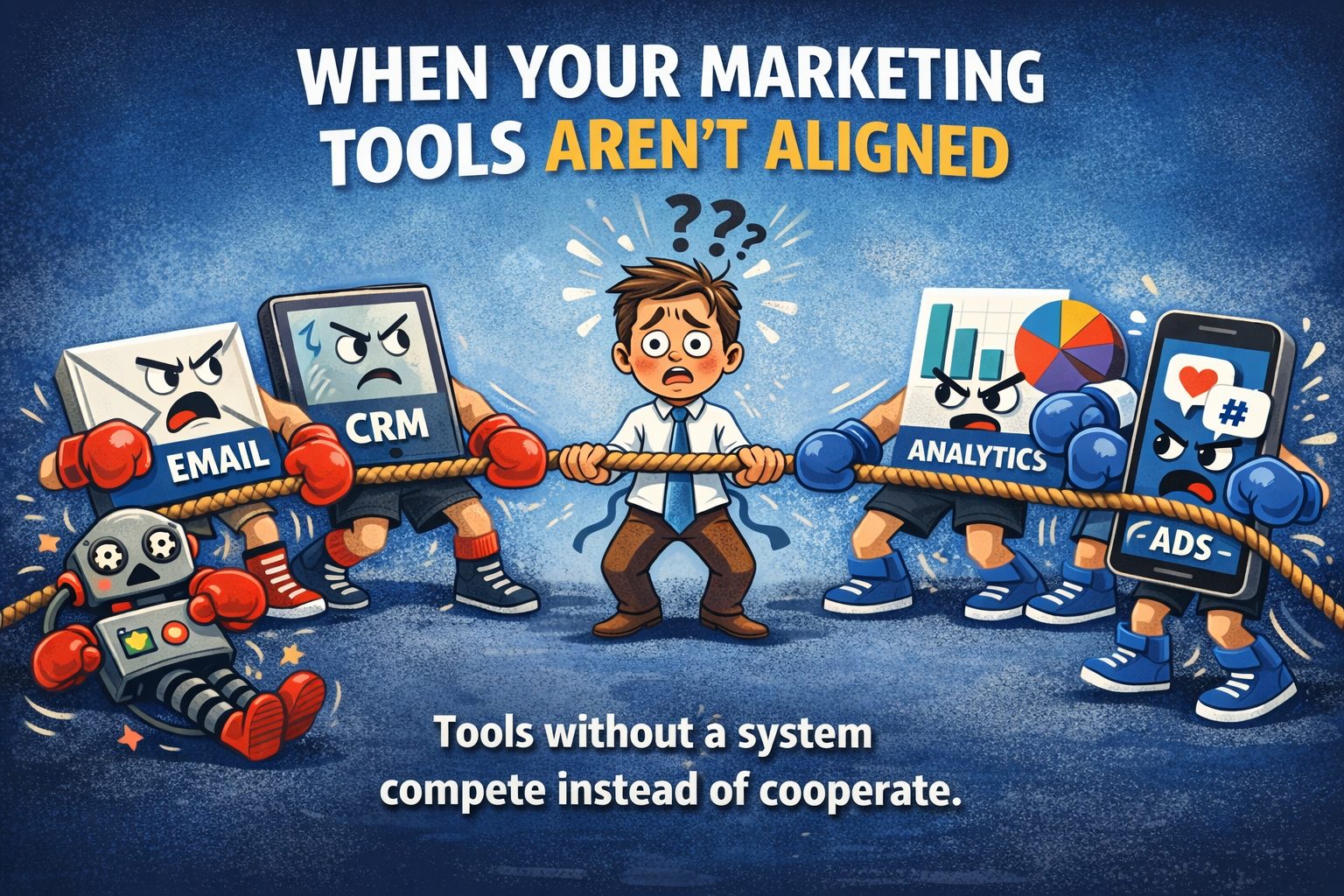
But when they aren’t designed to work together, they often start behaving less like a system and more like coworkers arguing in the break room.
Your email tool says one thing.
Your CRM says another.
Your analytics platform tells a completely different story.
And suddenly no one is quite sure which version of reality is correct.
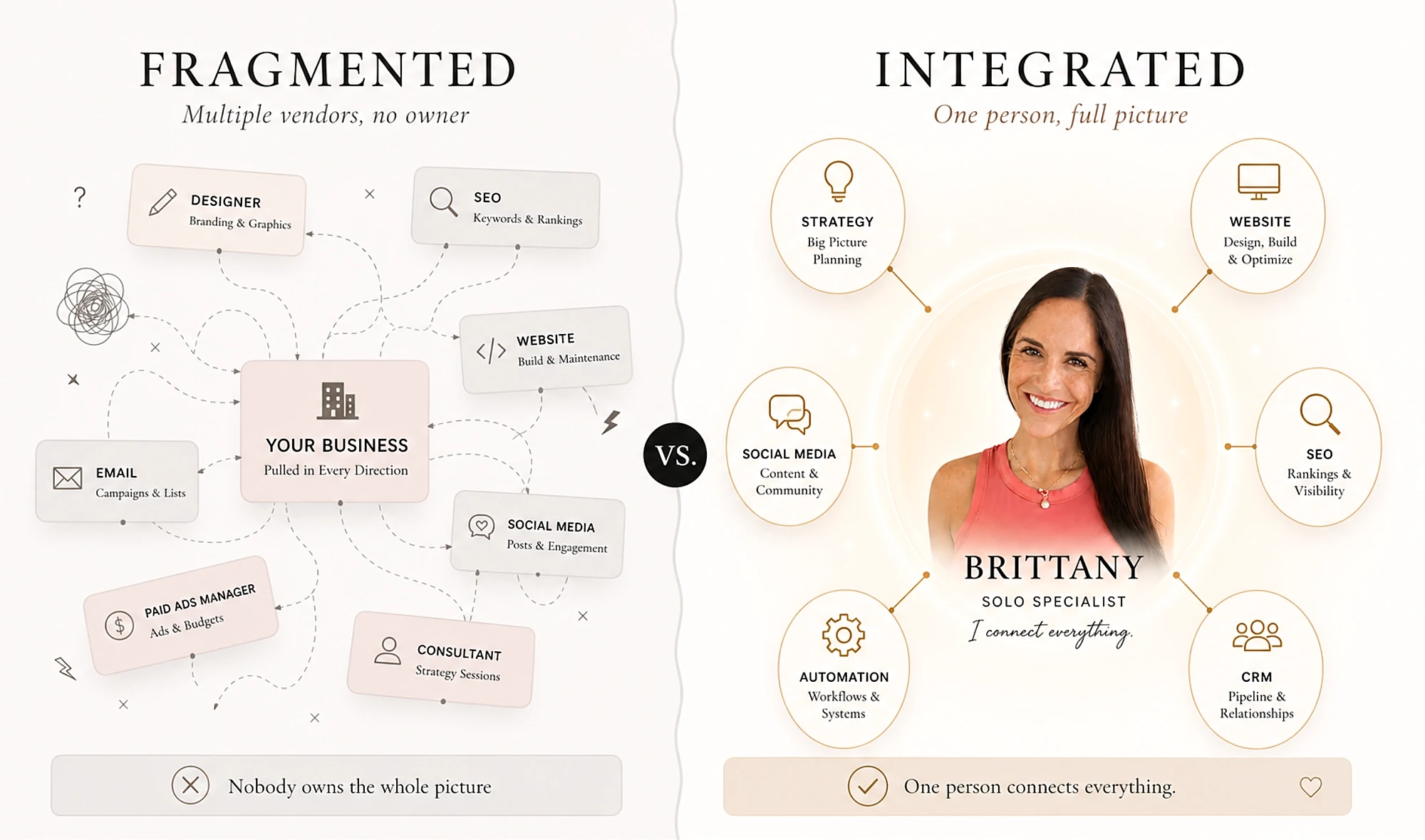

When Marketing Tools Stop Helping
Marketing tools are incredibly powerful when they support a clear strategy.
Without that structure, they tend to introduce more complexity than clarity.
This is one of the reasons many businesses experience what looks like active marketing — posts going out, emails being sent, campaigns running — while results remain inconsistent.
If that sounds familiar, you might recognize the patterns discussed in Why Your Marketing Looks Busy But Isn’t Actually Working, where marketing activity exists but momentum never quite builds.
The issue isn’t effort.
The issue is coordination.
The “More Tools” Trap
When marketing starts feeling messy, the natural instinct is to add something new.
A better CRM.
A smarter automation platform.
A tool that promises deeper analytics.
But adding tools without a system behind them often creates more friction.
Instead of simplifying marketing, the stack becomes harder to manage.
Teams spend time:
- Moving data between platforms
- Reconciling conflicting reports
- Rebuilding automations
- Troubleshooting integrations
And the original goal — generating leads and building relationships — quietly becomes secondary.
Quick Test
Are Your Marketing Tools Fighting Each Other?
- Do your marketing tools share the same contact data, or are there multiple lists floating around?
- Can you clearly see where a lead came from without digging through three platforms?
- Do follow-ups happen automatically and consistently, or are they manual?
- Does your reporting give one clear answer — or three conflicting ones?
Do your marketing tools share the same contact data, or are there multiple lists floating around?
Can you clearly see where a lead came from without digging through three platforms?
Do follow-ups happen automatically and consistently, or are they manual?
Does your reporting give one clear answer — or three conflicting ones?
What Marketing Tools Are Actually Supposed to Do
Marketing tools aren’t meant to operate independently.
They’re meant to support a coordinated marketing system.
In a well-structured environment:
- The website captures interest and inquiries
- The CRM organizes leads and conversations
- Automation supports follow-up
- Content and campaigns drive engagement
- Analytics reveal what’s working
Each component has a role.
When everything connects, marketing feels far calmer and more predictable.
If you’re curious how those pieces fit together, I explain the framework in The 7 Core Components of a Scalable Marketing System for Small Businesses.
Tools Work Best Inside a System
A marketing system gives your tools context.
Instead of acting like isolated apps, they become parts of a coordinated structure.
For example:
- Traffic arrives through content or campaigns.
- Visitors explore your website.
- Interested prospects submit an inquiry.
- Your CRM captures the relationship.
- Automation supports follow-up and nurturing.
Every step connects to the next.
This is the difference between marketing activity and marketing infrastructure.
If you want a deeper look at how these systems function, you can explore The Complete Guide to Marketing Systems for Small Businesses.
The Goal Isn’t More Tools — It’s Alignment
Many small businesses assume that better marketing requires a larger tech stack.
In reality, the opposite is often true.
The most effective marketing systems tend to be surprisingly simple.
A clear strategy.
A well-structured website.
A properly configured CRM.
Automation that supports real relationships.
Campaigns designed around a consistent message.
When those elements align, marketing becomes easier to manage and far more effective.
If you’re interested in the practical side of implementation, I walk through the process in How to Build a Marketing System for a Small Business (Step-by-Step).
Final Thought
Marketing tools are powerful.
But tools alone don’t create clarity.
Without a system guiding how they work together, they often compete for attention instead of supporting growth.
When marketing tools are aligned within a structured framework, something interesting happens.
Reporting becomes clearer.
Campaigns become more intentional.
Follow-up becomes consistent.
And suddenly the tools that once felt chaotic start behaving like they were meant to.
A system.