Why Marketing Systems Matter for Small Businesses
Connect strategy, messaging, tools, and campaigns to build consistent growth
Many small businesses assume marketing growth comes from doing more.
More posts.
More ads.
More tools.
More campaigns.
But sustainable growth rarely comes from more activity. It comes from structure.
Businesses that grow consistently usually operate within a clear marketing system—a connected framework where strategy, tools, messaging, and execution work together.
If you’re new to this idea, you may want to start with The Complete Guide to Marketing Systems for Small Businesses, which explains how marketing systems create consistency and momentum.
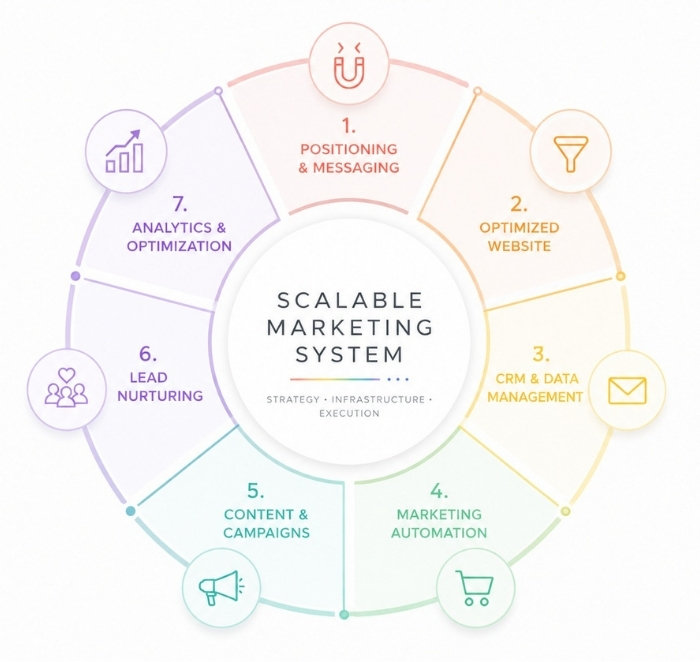
In this article, we’ll break down the seven core components of a scalable marketing system and how small businesses can begin building one.
Why Small Business Marketing Often Feels Disconnected
When marketing lacks structure, businesses often experience the same problems:
- leads falling through the cracks
- inconsistent messaging across channels
- disconnected tools and platforms
- campaigns that launch but never build momentum
Marketing starts to feel busy instead of productive.
This pattern is explored further in Why Your Marketing Looks Busy But Isn’t Actually Working, where many of these symptoms appear.
A strong marketing system solves this by ensuring every activity supports a shared strategy and measurable outcome.
The 7 Core Components of a Scalable Marketing System
1. Clear Positioning and Messaging
Every effective marketing system begins with clarity.
Your strategy should answer:
- Who are we trying to reach?
- What problem do we solve?
- Why should someone choose us instead of alternatives?
Without these answers, marketing quickly becomes scattered.
If your messaging feels inconsistent or unclear, it may be helpful to explore Why Most Small Businesses Don’t Have a Marketing Strategy, which explains how strategy shapes every marketing decision.
2. A Conversion-Focused Website
Your website should function as the central hub of your marketing system.
Rather than acting as a static brochure, a well-designed site should:
- communicate your value clearly
- guide visitors toward action
- support lead generation and inquiries
- reinforce credibility and expertise
For many businesses, the website becomes the anchor that connects advertising, content, social media, and email marketing into one coordinated system.
3. CRM Infrastructure for Small Business Marketing Systems
As businesses grow, managing contacts through spreadsheets or scattered tools quickly becomes inefficient.
A Customer Relationship Management (CRM) platform organizes interactions with prospects and customers so marketing and sales activity remain aligned.
A well-implemented CRM allows businesses to:
- track inquiries and conversations
- organize contacts and segments
- support consistent follow-up
- connect marketing with revenue outcomes
Platforms like HubSpot bring CRM, automation, and marketing tools together in a unified environment that scales as a business grows.
4. Marketing Automation for Small Business Marketing Systems
Automation allows small teams to operate with the efficiency of much larger organizations.
Common automation examples include:
- welcome email sequences
- lead nurture campaigns
- follow-up reminders
- triggered content delivery
- appointment confirmations
Automation works best when it supports thoughtful strategy, not when it attempts to replace it entirely.
As discussed in Why Marketing Is Not a “Set It and Forget It” System, even the best automation requires ongoing review and refinement.
5. Content and Campaign Systems That Support Small Business Growth
Consistent marketing visibility requires more than occasional content.
A scalable system typically includes:
- educational blog content
- email newsletters
- targeted campaigns
- lead magnets or resources
- social media support
The key is consistency and alignment. Every piece of content should support your broader marketing narrative and customer journey.
6. Lead Nurturing and Follow-Up
Many businesses generate interest but lose opportunities because follow-up is inconsistent.
A strong marketing system ensures that prospects receive:
- timely responses
- helpful resources
- relevant communication
- reminders or check-ins
This process turns casual interest into meaningful conversations and qualified opportunities.
7. Performance Tracking and Optimization
Without measurement, marketing becomes guesswork.
Tracking tools allow businesses to evaluate:
- traffic sources
- lead generation performance
- campaign effectiveness
- customer acquisition patterns
When data is monitored consistently, businesses can adjust strategy and improve performance over time.
Summary:
The 7 Components of a Scalable Marketing System
A strong marketing system brings several elements together so they work as one coordinated framework:
- Positioning & Messaging
- Conversion-Focused Website
- CRM Infrastructure
- Marketing Automation
- Content & Campaign Systems
- Lead Nurturing & Follow-Up
- Performance Tracking & Optimization
When these components work together, marketing becomes far more predictable and easier to scale.
Where Most Businesses Get Stuck
Many businesses attempt to build these components individually, but struggle to connect them into a cohesive system.
Common challenges include:
- disconnected marketing tools
- inconsistent follow-up processes
- unclear messaging across campaigns
- limited visibility into performance
Without structure, marketing activities often operate independently instead of supporting a shared strategy.

Creating Marketing Systems That Deliver Results
When marketing systems are designed intentionally, businesses experience meaningful benefits:
- clearer strategy
- stronger alignment across tools
- more consistent lead generation
- better visibility into results
Marketing stops feeling chaotic and starts feeling predictable, manageable, and scalable.
Instead of constantly reinventing the process, businesses operate within a structure that supports ongoing growth.
If you’re looking for a deeper explanation of how marketing systems work together, explore The Complete Guide to Marketing Systems for Small Businesses.


I Can Build You a Marketing System That Actually Works

Marketing growth rarely comes from adding more tools or more activity.
It comes from alignment.
When strategy, infrastructure, and execution operate as a connected system, marketing becomes calmer, clearer, and far more effective.
And that’s when real momentum begins.
Many small businesses know they need better structure, but aren’t sure where to start.
My approach combines marketing strategy, CRM infrastructure, automation, and hands-on execution to build systems that support measurable growth.
Ready to Get Your Marketing System Aligned?
Let's start with a conversation about where you are and where you want to go.
How to Build a Marketing System for a Small Business
Building a marketing system doesn’t require a large team or complex infrastructure. It begins with aligning a few essential components so marketing efforts support a clear growth strategy.
A typical process looks like this:
1. Define Your Audience and Positioning
Clarify who you serve, the problems you solve, and what makes your offering different.
2. Establish a Central Marketing Hub
Most businesses use a website or landing pages to capture leads and communicate their value.
3. Implement a CRM Platform
A CRM allows businesses to track inquiries, manage relationships, and organize contacts.
4. Create Automated Follow-Up Processes
Marketing automation ensures prospects receive timely and relevant communication.
5. Develop Consistent Content and Campaigns
Content and campaigns help attract attention and educate potential customers.
6. Monitor Performance and Optimize
Analytics tools allow businesses to evaluate results and refine marketing strategy over time.
When these elements are aligned, marketing moves from scattered activity to a structured system designed for long-term growth.
Frequently Asked Questions
Marketing Systems for Small Businesses
What is a marketing system for a small business?
A marketing system is the structure that connects strategy, tools, messaging, and execution so marketing efforts work together. Instead of running disconnected campaigns, a marketing system integrates elements like a conversion-focused website, CRM platform, marketing automation, and consistent content to support predictable lead generation and business growth.
Why do small businesses struggle with marketing systems?
Many small businesses begin marketing through individual tactics—social media posts, email campaigns, or advertising—without a central system tying them together. Over time this leads to disconnected tools, inconsistent messaging, and missed opportunities for follow-up. Building a structured marketing system helps unify these activities and ensures marketing supports long-term business goals.
What tools are typically included in a marketing system?
A strong marketing system usually includes a CRM to manage contacts and relationships, marketing automation to support lead nurturing and follow-up, a conversion-focused website, and analytics tools to measure performance. Platforms like HubSpot often bring these components together so businesses can manage marketing, sales, and customer engagement in one connected environment.
How do you build a marketing system for a small business?
Building a marketing system starts with defining a clear strategy and then connecting the tools and processes that support it. Most small business marketing systems include a conversion-focused website, a CRM to manage leads and customer relationships, marketing automation for follow-up and nurturing, consistent content and campaigns to attract prospects, and analytics to track performance.